

On 20 October, the wholesale electricity price in the Day-Ahead Market (DAM) reached 247 €/MWh, a yearly high, while from 19 October onwards it has consistently hovered above 200 €/MWh and much closer to 300 €/MWh by the end of the month (30 October).
At the same time, the price of fossil gas at the Title Transfer Facility (TTF) virtual natural gas trading point in the Netherlands (Title Transfer Facility, TTF) is at 100 €/MWh, three times higher than the period before the US-Israel war with Iran. Finally, gas storage facilities in the European Union (EU) are only 74% full, well below the seasonal average (around 86%).
Why does this matter for electricity prices?
The wholesale electricity price in Greece and the majority of EU Member States is determined based on the common market architecture, the so-called target model.
And while under this model Renewables (RES) are dispatched first by the system because they are the cheapest (merit order), the daily average wholesale price (DAM) is largely set by the last unit brought online to meet demand. In Greece, this unit is almost always a natural gas-fired power plant.
The specific weight of gas in Greece’s power generation mix
This is due to two reasons. First, storage has a particularly low share in Greece’s energy mix, which could otherwise “shift” RES generation to hours when there is no sun and no wind. Second, fossil gas has a particularly high share in power generation.
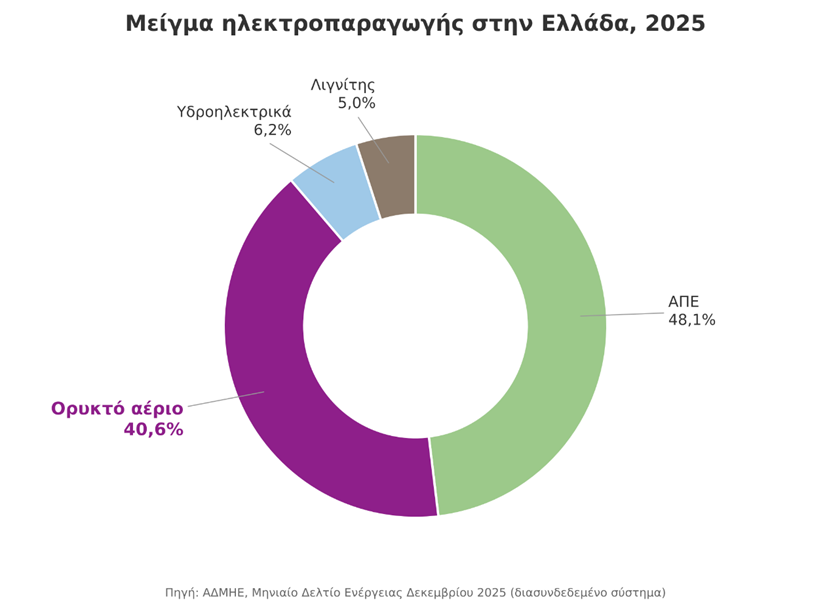
Data from the Independent Power Transmission Operator (IPTO) show that 40.6% of power generation in Greece in 2025 was covered by fossil gas plants, whereas, according to Ember data, the Union average was 16.7%.
Two studies illustrate the relationship between the price of gas and the day-ahead market (DAM) wholesale electricity price. The Centre for Planning and Economic Research (KEPE) examined the period from January 2018 to December 2022 and found that a 10% increase in the price of gas is associated with an increase of approximately 7% in the DAM, and about 7.5% from June 2021 onwards, when the crisis began. The think tank “The Green Tank” showed that the wholesale price closely follows gas-fired generation: the more gas is burned, the more expensive the DAM (correlation coefficient of 0.76 in the first half of 2025).
Consequently, the high share of fossil gas in power generation and the close link between the DAM and the TTF gas price render the Greek system vulnerable to gas price fluctuations. They prevent renewables from reducing the wholesale DAM price, despite their large share in power generation (48.1% for 2025).
The energy crises of our times are fossil fuel crises
These characteristics have made the electricity market in Greece particularly vulnerable, and ultimately consumers, onto whom almost the entire cost of the crises is passed, as tools that could, to some extent, offset the risks from price fluctuations do not function. The forward market remains shallow, almost inactive, nearly six years after the launch of the target model in November 2020. Long-term power purchase agreements (PPAs) are progressing slowly, and the share of self-generation is very low, at just 8.6% of total installed capacity.
The energy crisis as a result of the war between Russia and Ukraine
The energy crisis caught the EU unprepared and still heavily dependent on Russian fossil gas. The bill for the Union’s mistaken choice to give fossil gas a key role in the energy transition is being paid by consumers, households and businesses. Gas prices on the TTF soared from February 2022 onwards, reaching an all-time record of €339/MWh on 26/8/2022.
In Greece, the average DAM wholesale price for 2022 stood at €283/MWh, whilst in August and September it had even exceeded €400/MWh. Fossil gas covered 35.4% of electricity demand.
The “common” European response and the “exceptions”
The “joint” European response to the 2022 crisis comprised two legs. The first was REPowerEU, aimed at reducing dependence on Russian gas, focusing on the diversification of sources and the acceleration of the energy transition. The second leg concerned a series of emergency regulations regarding prices. Member states committed, among other things, to reduce gas consumption by 15% and electricity consumption by 5% during peak hours, and to fill storage facilities to 90%. A cap of €180/MWh was set on the revenues of low-cost power plants, such as RES, and part of the windfall profits of fossil fuel companies was taxed.
However, the situation in the member states was so volatile that it led each government to implement a variety of measures to relieve consumers, particularly of electricity.
According to Bruegel, between September 2021 and June 2023, member states allocated 540 billion euros to national measures. France capped tariff increases at 4% and fully nationalised EDF, the country’s largest power producer and supplier. Germany abolished the surcharge for renewables and introduced a cap of 40 cents/kWh on electricity prices. Italy abolished system charges and extended the social bonus to 5.2 million households. Belgium reduced VAT on electricity from 21% to 6%, while Romania capped retail prices and required producers to sell via the OPCOM exchange at a fixed price of 450 lei/MWh.
The Iberian countries managed to secure an “exception” to cap the price of gas used by power generation plants and compensate the units for the difference. This brought down the wholesale electricity price for everyone. The cap started at €40/MWh and was set to rise gradually to €70/MWh, while the budget was €8.4 billion (€6.3 billion for Spain and €2.1 billion for Portugal). The difference was mainly paid for by consumers themselves, via a special charge, and revenues from the interconnection with France.
In Greece, the main measure was subsidies. According to a report by the think tank The Green Tank, between September 2021 and December 2022, EUR 10.7 billion was spent on support measures. Of this amount, EUR 9.78 billion went towards subsidies for electricity and gas bills, of which EUR 8.04 billion was for electricity alone. The largest share, EUR 8.2 billion or 77%, was channeled through the Energy Transition Fund. The Fund was financed primarily by the producers’ excess revenue recovery mechanism (EUR 2.89 billion), ETS emission allowance auctions (EUR 1.78 billion), the state budget (EUR 1.6 billion) and RES account ELAPE (EUR 1.1 billion), while the windfall tax on producers yielded just EUR 0.37 billion.
Twenty-seven countries, one market, and almost as many solutions as there are countries.
The energy crisis triggered by the US-Israel war with Iran revives demands for exemptions
Today, almost four years later and one energy crisis later—driven by the US-Israel war with Iran and with natural gas and electricity prices heading upwards—Italy is also claiming an “exemption” in order to reduce its wholesale price. It is worth noting that 47.3% (Ember) of Italy’s electricity generation was covered in 2025 by natural gas-fired plants.
On October 16, it secured a preliminary agreement with the European Commission to introduce a €59/MWh cap on fossil gas used for electricity generation. Above this price, generators will be compensated for the difference up to the price at which they actually purchase the fuel. For example, with gas at €88/MWh, the compensation will reach €29/MWh. The cost of this “exemption” will, of course, be borne by consumers through their electricity bills.
Do we need deviations or… fewer fossil fuels?
Exemptions and subsidies buy time, using public money or consumers’ money. In essence, however, they subsidise the fossil gas itself that causes the crises. In the Iberian Peninsula, while the exemption was in place, gas demand for power generation increased by around 25% compared to what it would have been without it, according to a study by the University of Cambridge.
Spain is also showing the other way. Under the same pricing rule, gas now sets the price of electricity in just 15% of hours, down from 75% in 2019, thanks to renewables. The structural decoupling of electricity prices from gas comes through renewables, storage and electrification.
For countries like Italy and Greece, this is urgent. The high share of fossil gas in their electricity generation, and especially in Greece the lack of storage and hedging “tools”, make them even more vulnerable to the energy crises of our times.
The question for the EU remains: how many more crises until it addresses the fossil elephant in the room and accelerates the transition?
Sources:
- HEnEx – Hellenic Energy Exchange. Day-Ahead Market, market results. https://www.enexgroup.gr/el/home
- Trading Economics. EU Natural Gas TTF. https://tradingeconomics.com/commodity/eu-natural-gas
- Gas Infrastructure Europe (GIE). AGSI – Aggregated Gas Storage Inventory. https://agsi.gie.eu/
- ENTSO-E. Single Day-Ahead Coupling (SDAC). https://www.entsoe.eu/network_codes/cacm/implementation/sdac/
- Regulation (EU) 2019/943 of the European Parliament and of the Council of 5 June 2019 on the internal market for electricity. EUR-Lex. https://eur-lex.europa.eu/legal-content/el/TXT/?uri=CELEX%3A32019R0943
- IPTO (February 2026). Monthly Energy Bulletin, December 2025. https://www.admie.gr/sites/default/files/attached-files/type-file/2026/02/Energy_Report_202512_v2_gr.pdf
- Ember. Electricity Data Explorer, EU-27, power generation shares by source. https://ember-energy.org/data/electricity-data-explorer/?multi=false&entity=EU&chart=single_year&metric=pct_share