Supporters of the Vertical Corridor for fossil gas transport praise it as a tool for energy security, decoupling from Russia and establishing Greece as a regional energy hub. However, behind the strong political rhetoric, critical questions emerge regarding economic and geopolitical uncertainty, energy insecurity, and long-term commitment to a fossil fuel with a heavy environmental footprint. The only certain winner is the US gas industry.
At a time when European policies provide for a gradual reduction in fossil fuel consumption and scientific data show that the impact of hydrocarbon use is dangerously burdensome for the environment, a significant part of the political debate in Greece focuses on transforming the country into an energy hub for gas imports and transit. This same period is dominated by two wars that highlight the insecurity and conflicting geopolitical character of dependence on hydrocarbons.
The idea of the Vertical Corridor began in December 2014 as a trilateral initiative to interconnect the gas transmission systems of Greece, Bulgaria and Romania, following the collapse of South Stream. Meanwhile, the war in Ukraine brought new data, as the exclusion of Russia from European gas markets opened the market to higher-cost gas from the US, while subsequently the project was expanded and currently includes system operators from nine countries.
Corridor in three phases
A brief review of the history of the Vertical Corridor can be summarised in three phases:
Phase A (2014-2022): Tripartite interconnection agreement
- December 2014: The energy ministers of Greece, Bulgaria and Romania sign a joint declaration on the creation of a corridor that would facilitate “the transit of gas from the Aegean to the Black Sea“.
- March 2015: Meeting of the three energy ministers in Sofia. Signing of a memorandum for the construction of the Greece-Bulgaria gas interconnector (ICGB).
Phase B (2022-2024): Exclusion of Russian gas
Following the Russian invasion of Ukraine, the strategic narrative shifted towards weaning off Russian gas. In December 2022, a new memorandum of understanding was signed between system operators from Greece, Bulgaria, Romania and Hungary, with an explicit focus on LNG and alternative gas supply sources. In 2023, the Alexandroupolis LNG terminal received final approval, while Ukraine is beginning to emerge as a final recipient, whose huge storage facilities are a target for securing a route to European markets: Ukraine ranks third globally in underground gas storage facilities, after the US and Russia. Indeed, in 2023 Ukraine’s Naftogaz
Phase 3 (2024 – ) US Gas Corridor
The pursuit by the US of a leading role in European gas markets is turning towards the practical transformation of the Vertical Corridor primarily, if not exclusively, into a route for channeling US-origin gas to European markets.
- November 2025: At the 5th P-TEC conference in Athens, US representatives praise the VC as a means of channeling US gas from terminals in Greece to Central and Eastern Europe.
- February 2026: Thirteen energy ministers were invited to Washington by the White House to sign a joint statement of interest for the supply of US LNG via the Vertical Corridor. The US Department of Energy described the corridor as a mechanism creating significant opportunities for the expansion of US LNG exports through Greece. The content of the memorandum was published in Greek media.
- June 2025 – April 2026: Following a series of failed auctions, in which either no capacity was booked at all or bookings via the Vertical Corridor were negligible, an auction in June 2026 recorded some interest in specific sections of the system by Greek companies.
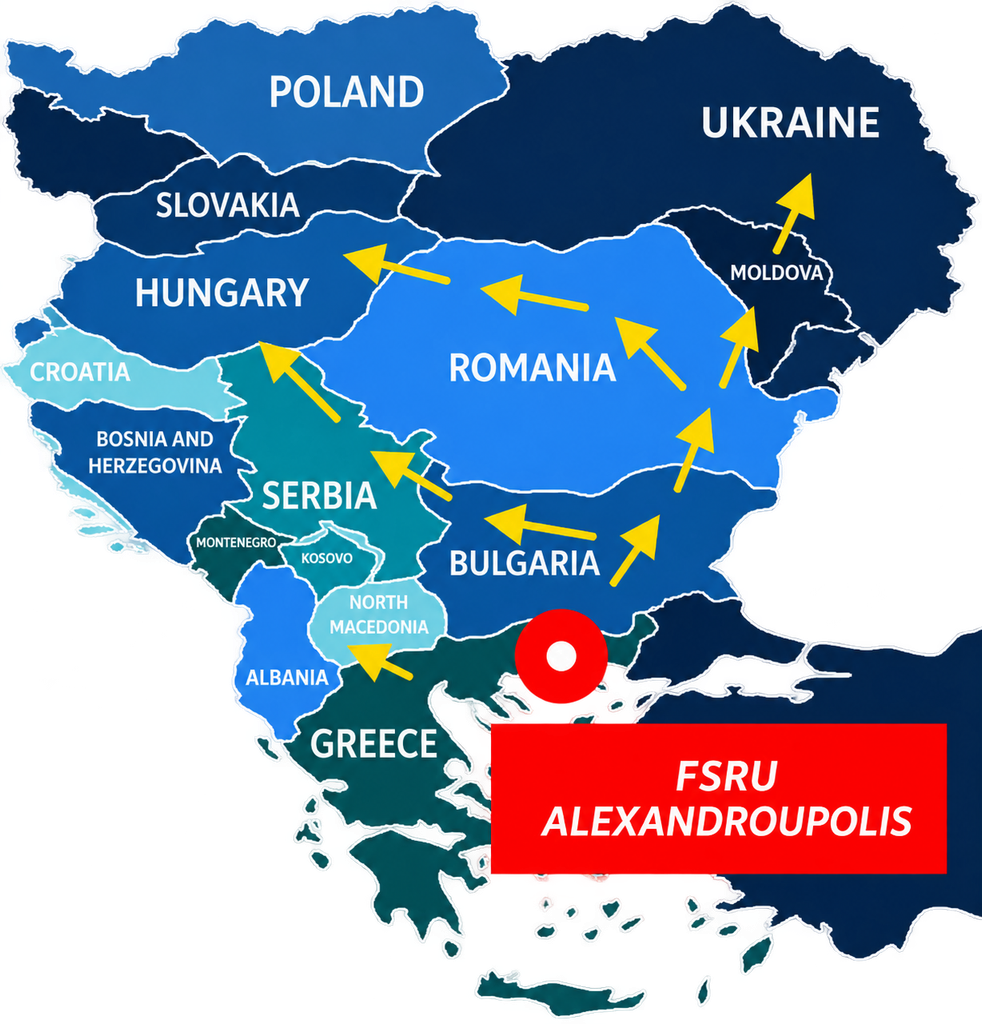
The corridor of many faces: Map of the Vertical Corridor as pursued by the United States Energy Association. Today, gas transit from Greece takes place via three existing routes: Route 1 (exit from Sidirokastro towards the IGB), Route 2 (from Amphitrite), Route 3 (from Komotini). Source: United States Energy Association.
The routes currently available in capacity auctions are the following three, and are based on existing gas transit infrastructure with the following interconnection points:
Route 1: Sidirokastro – Kulata (interconnection point between DESFA and BULGARTRANSGAZ), Negru Voda – Kardam (interconnection point between TRANSGAZ and BULGARTRANSGAZ), Isaccea-Orlivka (interconnection point between TRANSGAZ and Gas TSO of Ukraine LLC), Căușeni, Grebenyky.
Route 2: Alexandroupoli LNG terminal, Amfitriti, Komotini, Stara Zagora, Kardam (Bulgaria) – Negru Voda (Romania), Isaccea (Romania) – Orlivka (Ukraine), Căușeni (Moldova), Grebenyky (Ukraine).
Route 3: Komotini (TAP-IGB pipeline), Stara Zagora, Negru Voda 1 / Kardam – Isaccea 1 / Orlivka, Căușeni, Grebenyky.
Serious objections and concerns arising regarding the creation and operation of the Vertical Corridor are summarised in the following four points.
Objections to the legality of the auctions
During the capacity allocation consultation for the first route from Greece to Ukraine (Route 1), strong objections were raised in writing by the European energy traders’ association, Energy Traders Europe (ETE), regarding compliance with the EU acquis. Specifically, ETE raised objections concerning the lawful application of the provisions of the regulations on gas networks and markets, namely Regulations 2017/459 establishing a network code on capacity allocation mechanisms and 2017/460 establishing a network code on harmonised transmission tariff structures for gas. In its relevant decision, RAAEY appears to bypass these objections, responding that “the provision of this product should be considered as taking place within the framework of EU Solidarity with Ukraine […] which has been fighting against Russia for over three years.”
High cost for gas via the Vertical Corridor
As is already becoming apparent, the financial cost of the gas to be supplied via the Vertical Corridor is one of the main issues rendering it uncompetitive and unappealing in a European market which, despite opposing pressures, is moving towards a phase-out of high-cost fossil fuels.
In a report published in June 2025 by the Energy Community secretariat,[1] reasons are identified that render the commercial attractiveness of the TBP unsustainable. The proposals, which were formulated following a “broad and inclusive consultation with key European and national stakeholders, including transmission system operators (TSOs), the European Network of Transmission System Operators for Gas (ENTSOG), the European Union Agency for the Cooperation of Energy Regulators (ACER), the European Commission, national regulatory authorities (NRAs) and market participants“, indicate that the gas products auctioned so far show significant deviations from the two European regulations. Specifically, the report highlights factors that reduce the commercial attractiveness of the TBP, which are also mentioned by Energy Traders Europe in terms of their intensity and concern tariff adjustments and special discounts that should be applied at entry points rather than selectively, while auction dates and the relevant algorithms must be published on the relevant European platform.
However, as authoritative analyses show, the cost of this route can be 21% to 76% more expensive compared to competing routes (The Green Tank, 2026). Corresponding high-cost data are also provided by the report presented by the Energy Community (op. cit.), which analyses the economics of gas transport via existing Trans-Balkan routes (which are the backbone of the Vertical Corridor) as the greatest obstacle to achieving commercial competitiveness. Specifically, the report compares transport from Greece with alternative transport routes via Serbia/Hungary and Romania/Hungary, with the results clearly showing a hard-to-overcome cost difference:
| Route | Annual transmission cost (€/MWh) |
| LNG via Greece to Ukraine | 10.3 (from Revithoussa) – 11.73 (from Alexandroupolis) €/MWh |
| LNG via Serbia / Hungary | 5.6 €/MWh |
| LNG via Romania / Hungary | 5.7 €/MWh |
The report calculates the cost of transporting LNG from Greece to Ukraine to be approximately double that of existing routes via Serbia / Hungary and Romania / Hungary.
LNG and the Vertical Corridor
As part of the broader effort—particularly by the US government—to create a Vertical Corridor stretching across almost the entire Balkan region, commitments are being sought at the intergovernmental level for the purchase of US gas. The agreement between the Greek consortium Atlantic SEE LNG Trade (DEPA Commercial and the Aktor Group) and the US company Venture Global fits into this political context. The agreement provides for long-term LNG supply commitments, securing predictable demand for the US company for the coming years. The Greek partners have committed to receiving significant quantities of LNG from Venture Global and subsequently finding buyers along the corridor. However, buyers do not yet appear to be guaranteed, as the results of capacity auctions have not confirmed the picture of strong commercial demand that accompanies the political statements.
The climate footprint of LNG
At the same time, serious issues arise regarding the climate footprint of gas and, of course, the undermining of prospects for energy independence and security. The European Union has adopted a target to reduce net emissions by 90% by 2040 and achieve climate neutrality by 2050. Within this context, the creation of new gas infrastructure and the conclusion of twenty-year contracts keep energy systems locked into gas use long beyond the time horizon provided for by climate targets.
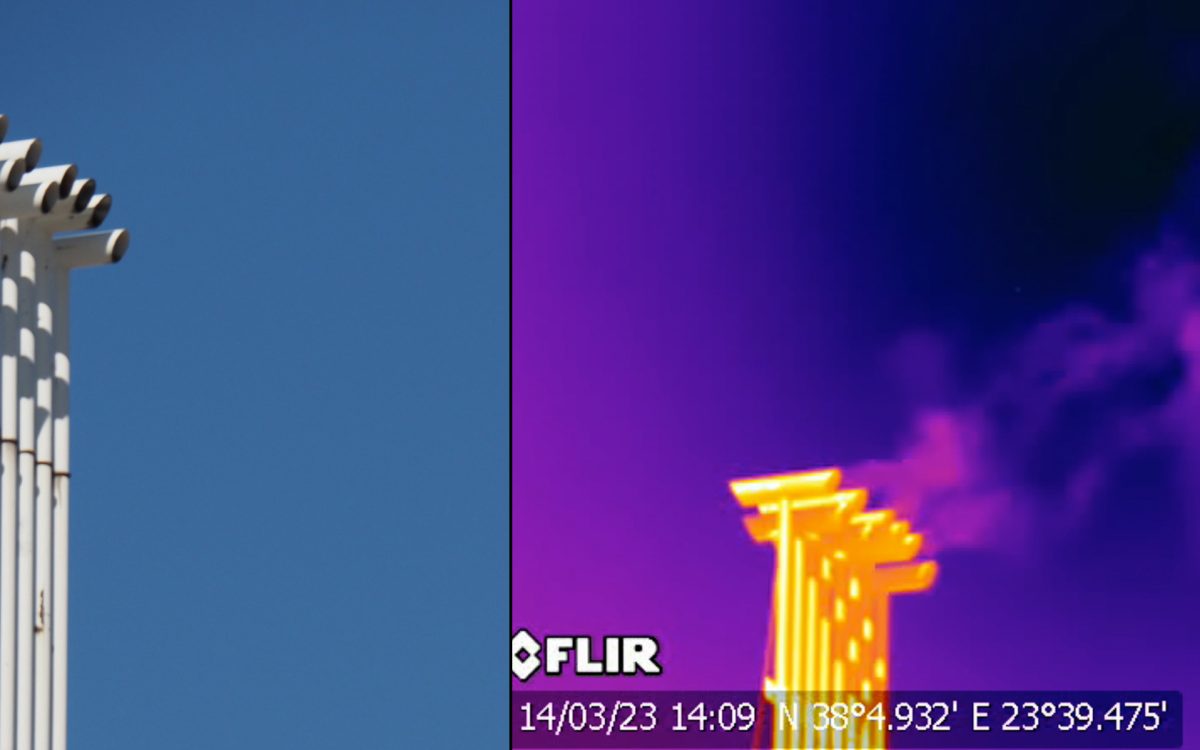
Contrary to the heavily promoted claim that LNG is an environmentally “clean” fuel, it is important to point out that LNG is nothing more than fossil gas that has been cooled to -162°C in order to liquefy and be transported more easily over long distances. However, behind the technical convenience of transport lies a serious climate cost: the main component of the gas, methane, is one of the most potent greenhouse gases and is responsible for about one-third of current global warming. Throughout the LNG chain, from extraction and liquefaction to transport, storage and regasification, methane emissions occur through leaks, venting and flaring. These emissions are often underestimated, despite being of decisive importance for the fuel’s true climate footprint.
It is estimated that one-third of global warming to date is due to methane, making emission reductions a critical priority, as its relatively short atmospheric lifespan allows for rapid results. The urgent need for international action to curb methane emissions is highlighted once again by the recent Emissions Gap Report 2026 from the United Nations Environment Programme, which annually illustrates the gap between actual emissions and tolerable greenhouse gas concentrations in the atmosphere in order to keep global warming at the “tolerable” level of 1.5oC. Specifically, the UNEP report points out once again that “methane emissions are heading in the opposite direction” relative to scientifically established and internationally agreed pathways. In conclusion, the push for expanding gas infrastructure and long-term LNG purchase agreements leads to a lock-in of long-term dependence on fossil fuels, higher cumulative carbon dioxide emissions, the perpetuation of methane emissions along the supply chain, and the diversion of public resources and policy focus away from necessary investments in energy efficiency and storage, grids, and electrification.
[1] The Energy Community is an international organization aimed at extending the operating rules of the European energy market beyond EU borders, facilitating energy cooperation with neighbouring countries and supporting their path towards European integration. Albania, Bosnia and Herzegovina, Georgia, Kosovo, Moldova, Serbia and Ukraine participate in the Energy Community.