In a report published on September 22, the International Energy Agency (International Energy Agency – IEA) emphasizes that shifting final energy consumption from fossil fuel combustion to electricity is essential, alongside the transformation and reinforcement of electricity grids, so that they rely on renewables with storage and can respond to the increase in demand.
The main conclusions of the report, which was requested by Turkey and Australia, the two co-hosting countries of the 31st UN Climate Change Conference (COP31) to be held in November in Antalya, are as follows:
- The target for 35% electrification is necessary and achievable by 2035
The analysis concludes that available and cost-effective technologies can make a target achievable where 35% of final energy consumption is covered by electricity.
- Electrification reduces exposure to the uncertainty of oil markets
The IEA argues that countries can enhance their energy security, competitiveness and greenhouse gas emission performance by replacing the direct consumption of fossil fuels with electricity, particularly when this is increasingly generated from domestic low-emission sources.
- The energy crisis highlights the vulnerability of fossil fuel dependency.
Conflicts in the Persian Gulf and the closure of the Strait of Hormuz have demonstrated how quickly reliance on internationally traded oil and LNG can transmit geopolitical shocks to domestic energy prices. The IEA presents electrification as a way to limit this exposure to external risks.
- Electricity is already the fastest-growing energy carrier
Global electricity demand is growing driven by electric vehicles, heat pumps, cooling, industry, electrical appliances and data centres. It is estimated that global electricity demand will increase by 3.6% in 2026 and by 3.8% in 2027.
- Priority for zero-emission power generation
Electrification does not automatically reduce emissions. Its benefits increase as electricity generation becomes cleaner. Renewables are expected to become the largest source of electricity generation globally in 2026, with their share rising from 33% of global electricity generation in 2025 to 37% in 2027.
Specifically for Europe, the IEA estimates that approximately 70% of EU electricity generation already comes from domestic low-emission sources, while end-consumers in industry, buildings and transport cover less than a quarter of their energy needs with electricity. This means that the greatest untapped opportunity for enhancing energy security now lies on the demand side.
The course of electrification in Greece
Despite the increase in RES electricity generation in our country, this does not go hand in hand with corresponding progress in electrification in critical sectors that still depend on fossil fuels, such as transport. Regarding transport in particular, the European Commission’s latest report on the performance of the Greek economy highlights as a priority the decarbonisation of the transport sector, which remains a major source of greenhouse gases. In its recommendations for shielding the Greek economy from the cost of dependence on oil and gas, the European Commission points out the need to readjust the tax system to strengthen incentives for electrification. It also reiterates the directive to phase out fossil fuel subsidies across all sectors.
According to Eurostat data for 2024, Greece ranks second to last in the EU in the use of renewable energy in transport, with a share of just 3.8%. Across Europe, Norway leads the way in transport electrification with an impressive 33% share for 2024.
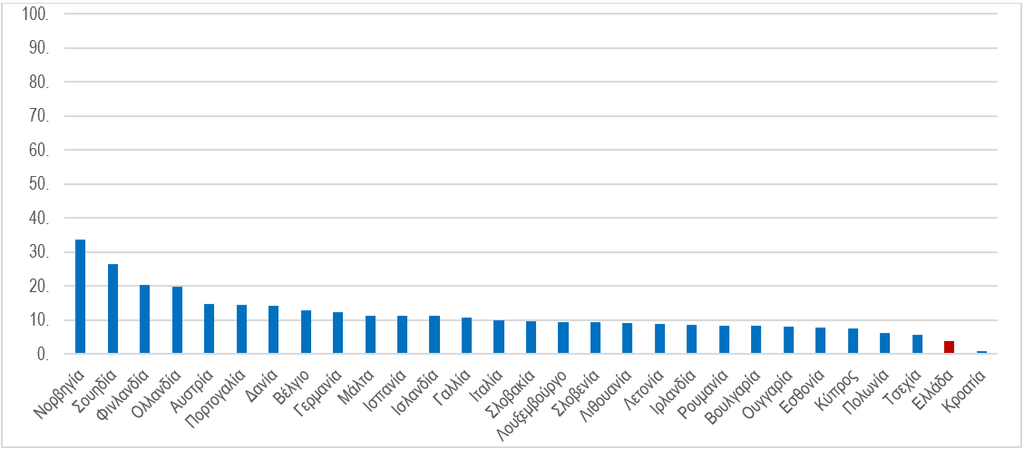
Eurostat: Share of renewable energy use in transport (% of the total) for 2024
The IEA’s core message is that electrification is no longer simply a tool for reducing emissions. In an era of geopolitical energy crises, it is transforming into a strategy for energy security: the more transport, buildings and industry run on increasingly domestic clean electricity, the less exposed economies are to oil and gas imports.