Climate change, understandably due to its visible impacts on everyday life and the country’s ecosystems, remains one of the major concerns for citizens in Greece. At the same time, support for measures to reduce methane emissions appears exceptionally high, according to the results of an annual survey conducted by the international organisation Global Methane Hub. The survey was conducted in August 2026 across 18 countries worldwide, including Greece. The results concerning Greece were announced by WWF Greece.
According to the survey results, Greeks are already experiencing the impacts of climate change and directly connect extreme weather events with the environmental threats facing the country. Wildfires emerge as the single biggest local concern, with 96% of respondents stating that they cause them concern. These are followed by heatwaves (94%), climate change (90%) and drought (90%).
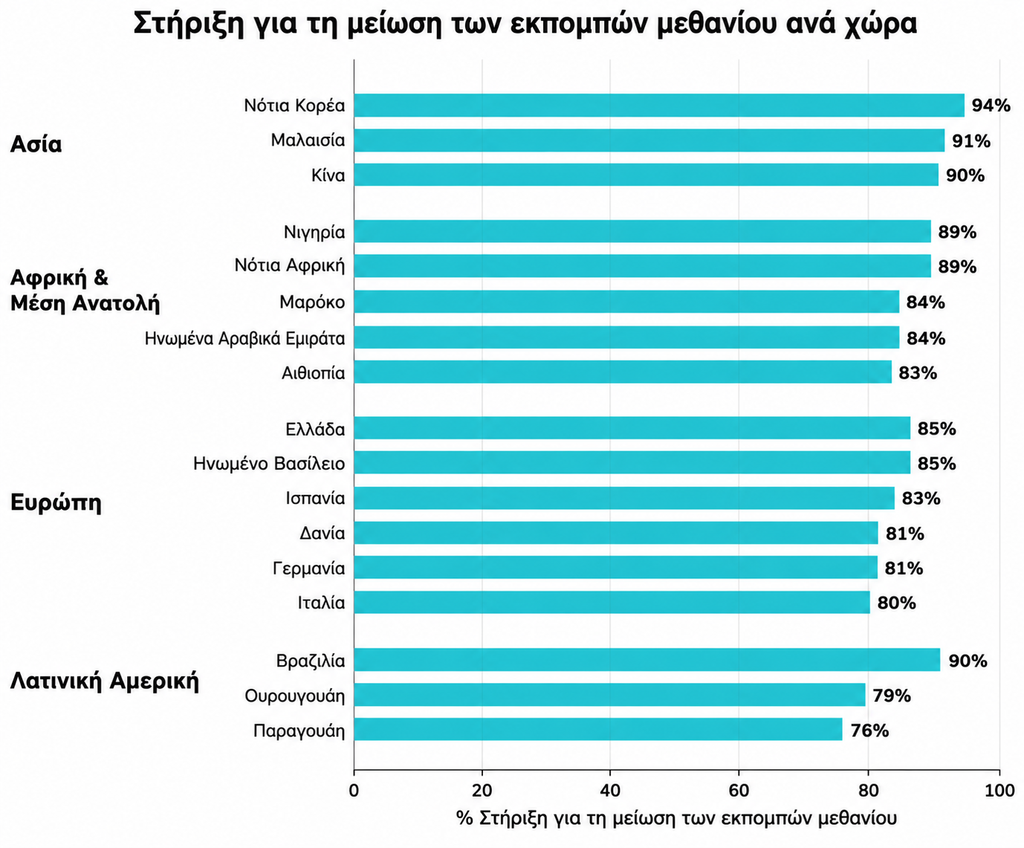
As shown in the table above, the results in the six European countries where the survey was conducted are revealing. The findings make political developments at the European Parliament level—which have been negative for methane legislation—appear paradoxical.
Specifically,
- Greece: 85% support taking measures to reduce methane emissions, while 90% are concerned about climate change. Concern is even higher for specific climate threats, as 96% express concern about wildfires and 94% about heat and heatwaves. Almost two-thirds (63%) believe that policymakers in Greece should do more to reduce methane emissions.
- United Kingdom: 85% support taking measures to reduce methane emissions, while 80% are concerned about climate change. More than half (54%) feel that British politicians should do more to reduce methane emissions.
- Spain: 83% support taking action on methane and 89% are concerned about climate change, while 96% state they are concerned about wildfires. 66% believe Spanish politicians should do more to reduce methane emissions.
- Denmark: 81% support taking action on methane and 77% are concerned about climate change. The majority (52%) believe Danish politicians should do more to reduce methane emissions.
- Germany: 81% support taking action on methane, an increase of 10 percentage points compared to 2024, while 79% are concerned about climate change. Half of respondents (50%) believe that German politicians should do more to address methane emissions.
- Italy: 80% support taking action on methane, while 92% are concerned about climate change and the same percentage (92%) are concerned about heat and heatwaves. Almost two-thirds (64%) believe that Italian politicians should do more to reduce methane emissions.
The majority of respondents clearly accept that climate change has human causes. Specifically, 75% agree that the climate is changing due to human activity, while just 4% believe that the climate is not changing. Furthermore, 84% state that they are concerned about climate change and 83% support actions to limit its impacts.
Despite the high level of concern, the survey reveals a significant information gap surrounding methane, one of the most potent greenhouse gases. Only 37% report being familiar with the term, while 63% state that they either have minimal knowledge or have never heard of it. Nevertheless, when citizens are informed about the role of methane in causing climate change, support for measures to limit it increases noticeably.
85% of respondents state that they support the reduction of methane emissions, while 63% believe that Greece should do more than other countries to curb them. In addition, half of the respondents state that they would view political figures who take action to reduce methane emissions more favorably.
Support for interventions in specific sectors is particularly high. 86% support measures to limit emissions from energy production and waste management, while 79% support corresponding interventions in agriculture and livestock farming. After participants were exposed to informative data on methane, these percentages increased further, reaching 87%-89%.
Another striking finding concerns waste management. 90% agree that Greece must strengthen policies to reduce food waste, promote food donation and improve organic waste management in order to limit the volumes ending up in landfills.
The research also shows that citizens find messages linking methane emission reductions to direct health and quality-of-life benefits compelling. Around eight in ten consider the argument that curbing methane pollution leads to cleaner and healthier communities to be credible.
Overall, the findings record a society that recognises the climate crisis as an immediate threat, overwhelmingly supports policies to reduce methane, and attributes significant responsibility to major fossil fuel companies. At the same time, they highlight the need for better public information regarding methane and the climate footprint of its anthropogenic emissions, as knowledge appears to significantly boost public support for ambitious climate policies.
The results of the Global Methane Hub survey are available here