The (reasonable) question “how much will the green transition cost?” is misleading, unless it is accompanied by a fundamentally important question: how much has our dependence on fossil fuels already cost us?
For decades, citizens and national economies have shouldered the price of an energy system built around oil, coal and fossil gas, not only through volatile energy bills and recurring energy crises, but also through billions in direct and indirect public subsidies designed to sustain that dependence.
The real debate is not only about the cost of moving away from fossil fuels, but also about the price we continue to pay for remaining locked into them. How much public money is spent each year to support the extraction, transport and consumption of fossil fuels? And what is the economic burden of the climate impacts, health costs and geopolitical vulnerabilities that come with that dependence?
In its recent recommendations on the state of the Greek economy and the ever-increasing cost of dependence on oil and gas—driven by geopolitical turmoil in the wider region—the European Commission reiterates its direction to phase out fossil fuel subsidies across all sectors. In its corresponding 2023 report, the Commission had estimated Greece’s fossil fuel subsidies at 1.3 billion EUR (for 2021). The Organisation for Economic Co-operation and Development (OECD), which has also repeatedly pointed out that fossil fuel subsidies in Greece are “particularly high”, maintains an open-access database on public subsidies in the energy sector. Specifically, in its 2024 report on the state of the Greek economy, the OECD notes that the total amount of fossil fuel subsidies for 2020 reached 1.9 billion EUR.
State subsidies for fossil fuels come in many forms. One of the most significant is capacity remuneration mechanisms, through which power plants burning coal, oil or gas are paid simply to remain open and available to the system. These state aid schemes are presented as tools to ensure capacity adequacy, but in practice they also act as life support for infrastructure that would otherwise face significant financial difficulties. According to openly available OECD data, between 2010 and 2024, the Greek economy paid €2,238,848,415 in state compensation solely to keep lignite-fired power plants in operation, while another €2,353,565,115 was paid to gas-fired plants respectively. The total amount of state aid that Greece reported to the OECD as having been paid annually within the framework of the state support for the use of fossil fuels in power generation amounted to 306,160.902 EUR.
At the same time, significant public funds have been channelled in recent years into new fossil gas infrastructure. A prime example is the LNG terminal and floating storage and regasification unit (FSRU) in Alexandroupolis, as well as the associated gas transmission infrastructure: the financial analysis provided to the European Commission’s services by the Greek authorities … “reveals that the project would not have been economically viable without state aid“.
This costly favouritism towards fossil gas infrastructure and, previously, also lignite creates a serious risk of lock-in to investments that may soon become economically unviable or obsolete.
The true economic cost of fossil fuels, however, is not limited to direct subsidies. It also includes the cost of fuel imports, the country’s exposure to international price volatility, air pollution, public health impacts, and mounting damage from the climate crisis. Extreme heatwaves, wildfires, floods and prolonged droughts are already translating into billions of EUR in economic losses for the state, businesses and households.
At a European level, fossil fuel subsidies soared to astronomical heights during the 2022 energy crisis and remained at exceptionally high levels in the following years. The European Environment Agency estimates that fossil fuel subsidies in the EU exceeded 111 billion EUR in 2023, while the European Commission estimates that they still amounted to approximately 97 billion EUR in 2024.
The critical conclusion is that the energy transition cannot be compared to an established reality that is mistakenly treated as if it were of “zero cost”. This is not simply because we have paid dearly for decades for our current dependence on coal, oil and gas through subsidies, but because the need to break away from fossil fuels is an existential necessity for humanity, societies and economies. Continued reliance on fossil fuels demands huge public resources, exposes the country to geopolitical risks and continually transfers costs to citizens through taxes, energy bills and environmental damage.
The real question, therefore, is not whether we can afford the green transition. It is whether we can afford the constantly increasing cost of delaying it. For a country like Greece, every additional euro invested in perpetuating our dependence on fossil fuels is one euro less for energy autonomy, economic resilience and climate protection. Fossil fuel subsidies are not merely a fiscal expenditure. They are an investment in the past, at a time when the country is called upon to finance its future.
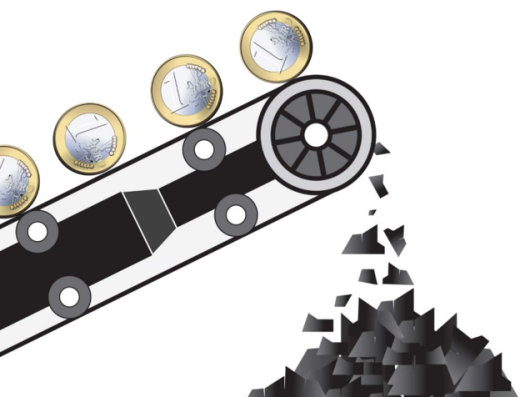
Cartoon: Marios Vontas
More sources:
- European Commission: 2026 Country Report – Greece. Recommendation on the economic, social, structural, budgetary and employment policy of Greece.
- European Commission. (2026). Report on energy subsidies in the EU. https://eur-lex.europa.eu/legal-content/EL/TXT/HTML/?uri=CELEX:52026DC0472
- European Environment Agency. (2025). Fossil fuel subsidies in Europe. https://www.eea.europa.eu/en/analysis/indicators/fossil-fuel-subsidies
- Organisation for Economic Co-operation and Development: Fossil Fuel Support – Detailed Indicators
- WWF: Greek fossil fuel subsidies (2018)