Europe’s decoupling from Russian natural gas after 2022 brought liquefied natural gas (LNG) to the forefront of European energy policy. For Greece, this development was accompanied by a new narrative: that the country can be transformed into an “energy hub” for Southeastern and Central Europe.
The diversification of supply sources is undoubtedly valuable for security of supply. However, replacing Russian gas with LNG does not constitute a decoupling from fossil fuels. It primarily changes the supplier and the mode of transport for the same fuel.
And this distinction becomes particularly important when current choices create commitments extending all the way to 2050.
An agreement until the era of climate neutrality
In November 2025, Atlantic-SEE LNG Trade, a joint venture between AKTOR and DEPA Commercial, signed a 20-year LNG supply agreement with US-based Venture Global, starting in 2030. In June 2026, the agreed minimum quantity was doubled from 0.5 to 1 million tonnes of LNG per year, while Venture Global also holds approximately 25% of the regasification capacity of the Alexandroupoli FSRU.
This is therefore a commercial commitment that begins in less than four years and extends essentially until 2050.
This raises an obvious question of compatibility with European energy policy. The EU has a legally binding climate neutrality target for 2050 and has proposed a 90% net emissions reduction by 2040. The European Commission itself points out that achieving these targets requires a reduction in the use of fossil fuels, including fossil gas.
The question, therefore, is not whether the agreement secures LNG. It is how much LNG Europe will actually need after 2035 and 2040.
LNG is not ‘clean’ natural gas
Natural gas produces less CO₂ when burned than coal. However, this does not describe its entire climate footprint — and particularly that of LNG.
For American natural gas to reach Greece, it requires extraction and processing, transport to the terminal, cooling to approximately -162°C to liquefy, transport by ship, and finally regasification.
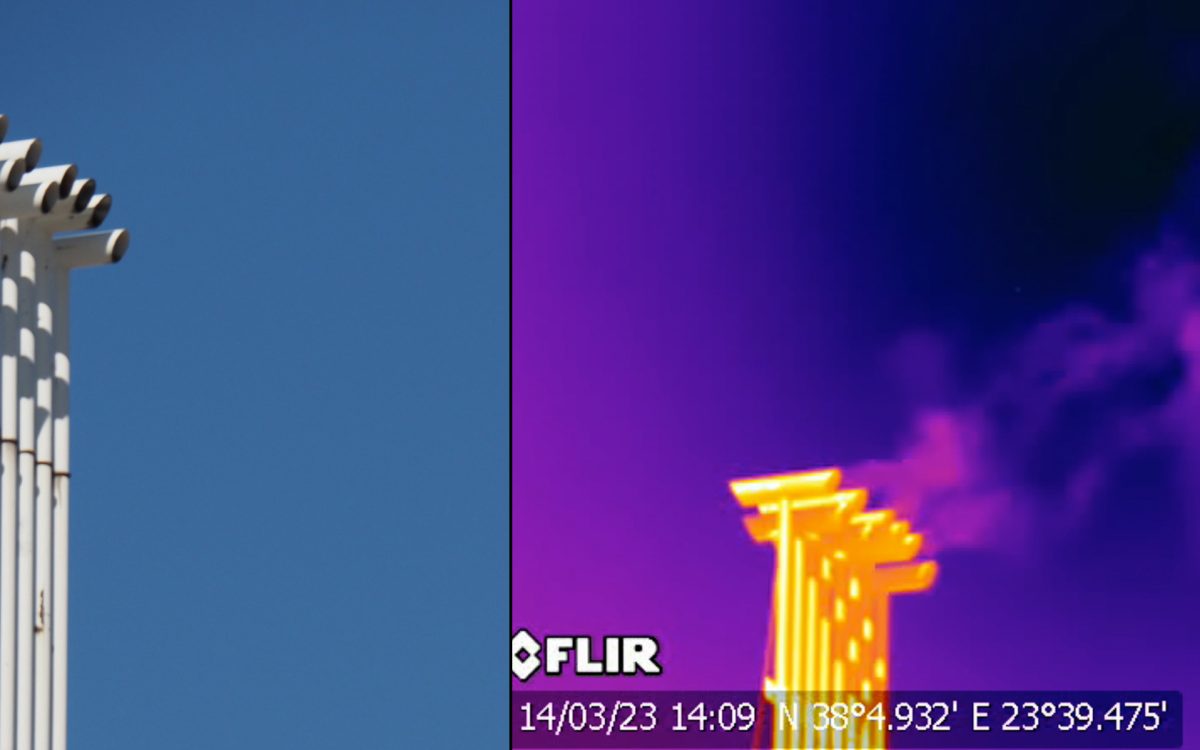
The International Energy Agency estimates that the LNG supply chain has, on average, higher emissions than natural gas supply in general, precisely because of the energy required for its liquefaction and long-distance transport. Emissions from the global LNG supply chain are estimated at approximately 350 million tonnes of CO₂-equivalent annually, with about 30% associated with methane escaping unburned into the atmosphere.
To these must be added the CO₂ from the final combustion of the gas.
The comparison with coal is therefore of limited value for a country planning its energy system for 2040 and 2050. The real question is not whether LNG is better than the most polluting fossil fuel, but whether new LNG investments are competitive against available zero- or very low-emission solutions.
From Russian dependence to a new dependence?
There is also the geopolitical dimension.
The ability to import LNG from different countries indeed reduces the risk of dependence on a single pipeline or supplier. This is a real advantage.
However, it does not eliminate energy dependence.
LNG remains an imported fuel traded on an international market. Its price and availability can be affected by wars, tensions in maritime trade routes, increased demand in Asia, production outages, trade disputes or policy shifts in major exporting countries.
Greece can therefore achieve greater geographical diversification while remaining exposed to international geopolitical and economic shocks.
Nor is the trend pointing towards lower consumption. In 2025, domestic natural gas consumption in Greece increased by 6% to 70.16 TWh, with power generation plants absorbing over 70% of this volume. Imports via Revithoussa surged by 63.3%.
The real energy hub
Turning Greece into a transit hub may have commercial and geopolitical significance. However, it must not be confused with the energy transition.
Energy security is not just about being able to buy the same imported fossil fuel from more countries. It is also about needing to buy less and less of it.
For Greece, more substantial strategic autonomy lies in domestic clean electricity generation, storage, stronger grids, electrical interconnections, energy efficiency, and the electrification of consumption.
LNG may have addressed an immediate security of supply problem following the Russian invasion of Ukraine. However, turning an emergency solution into a twenty-year strategic choice is a completely different matter.
And this is precisely what we should be discussing today: not only where Greece’s natural gas will come from, but for how much longer we want to need it.