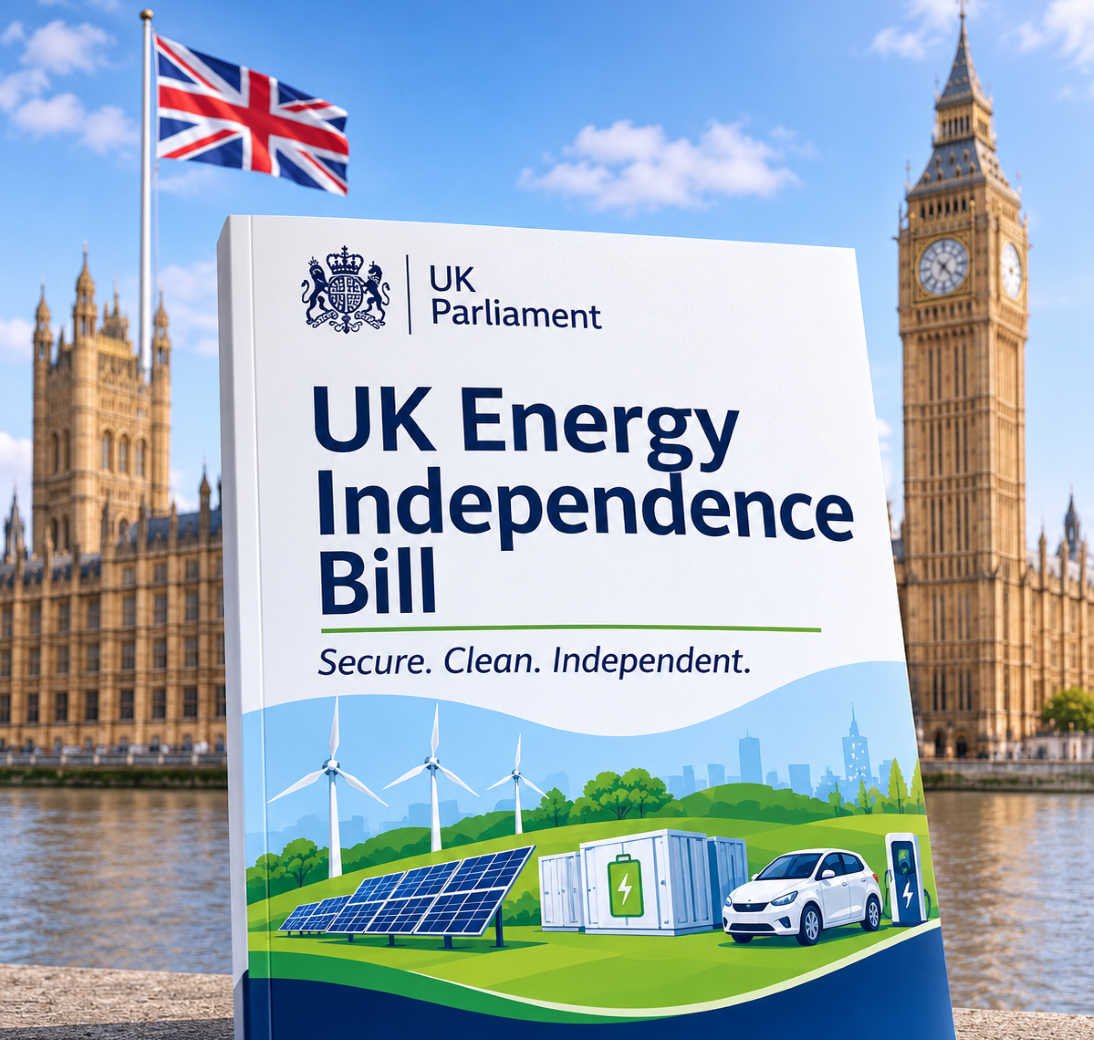
The “Energy Independence Bill“, which the British government published and presented in the House of Commons yesterday, undoubtedly represents one of the most significant shifts in British energy policy in recent decades. The government explicitly links energy independence not with the extraction of more fossil fuels, but with the development of domestic clean energy, electrification, and the reduction of exposure to international fuel markets. As stated in the government’s accompanying text, “the only way to protect citizens from future fossil fuel price shocks is to produce more of our own clean energy.”
The role of the North Sea Transition Authority
A central element of the bill is the upgrading and redefining of the mission of the Oil and Gas Authority and its renaming to the North Sea Transition Authority (NSTA). This is the state authority responsible for managing oil and gas extraction activities in the North Sea, which now inherits the powers of its predecessor hydrocarbon authority, without any reference to issuing licenses for the exploration and extraction of new oil and gas deposits.
The symbolic significance is evident even in the name. The former hydrocarbons authority bearing the title “Oil and Gas Authority” is officially being renamed the “North Sea Transition Authority”, a fact that reflects Britain’s strategic shift from promoting oil and gas extraction towards managing the energy transition in the hydrocarbons sector.
As emerges from the bill, this is more than just an administrative change. The authority’s mission is being transformed to manage the North Sea’s gradual transition to a new energy model, maintaining security of supply without pursuing the continuous expansion of extraction into new offshore areas.
This provision essentially marks the end of the policy of unceasingly expansionist extractive policy that dominated Britain for decades. The British government appears to understand that oil and gas prices are determined by international markets and that increased production in the North Sea cannot guarantee lower bills for households. As highlighted in the relevant presentation of the bill by the Department of Energy Security and Net Zero (Department of Energy Security & Net Zero), “the only way to protect citizens from future fossil fuel price crises is to produce more of our own clean energy right here in Britain. The bill removes barriers to the development of the clean energy infrastructure we need, from new power generation facilities to critical electricity grid upgrades, helping to create a safer, more resilient and efficient energy system.”
Energy transition certificates: managing the exit from
The bill does not propose a sudden shutdown of the hydrocarbon industry. Instead, it introduces a new framework through so-called Transitional Energy Certificates. The rationale is that existing fields and current licences will continue to operate until the end of their economic life, but within a new framework that provides predictability for businesses and workers.
Transition to renewables based on community benefit agreements
An important element of the bill is the institutionalisation of mandatory benefits for communities hosting clean energy projects. Specifically, the fifth part of the bill introduces provisions for the provision of community benefits by the operators of new power generation plants, while at the same time strengthening the role of community energy schemes and citizens’ participation in the ownership of energy projects.
New onshore wind farms and large photovoltaic projects will be required to contribute to special community funds, so that part of the economic value they generate is returned to local communities. At the same time, the bill enhances the ability of citizens to participate in the ownership of energy projects, allowing communities to acquire larger stakes in more renewable energy projects. This approach seeks to boost the social acceptance of the projects, generate local income and turn the energy transition from an external investment into a shared benefit for residents.
A message to Europe
The significance of the bill extends beyond Britain’s borders. At a time when several European countries are still planning new gas infrastructure with a lifespan of decades, London is choosing a different strategy.
The Energy Independence Bill argues that energy independence is not achieved through new drilling, but through more renewables, stronger grids, electrification, storage and energy efficiency. This approach aligns with analyses by the International Energy Agency, according to which achieving climate targets does not require new oil and gas deposits.
Historic shift
Although the bill includes a multitude of specific provisions for consumers, grids, energy communities and energy storage, its strategic “heart” lies in the recognition that the future of energy security is not linked to the expansion of fossil fuel production.
The pivotal role of the North Sea Transition Authority, combined with the end of new oil and gas licensing, marks a historic turning point in Britain’s break from the oil industry. If the bill is passed without substantial changes, the country will have institutionalised one of the clearest frameworks for transitioning from the hydrocarbon era to a zero-emission energy system, while also bolstering its energy independence.
Source: UK Parliament