Against the backdrop of the two wars in Europe’s wider neighborhood, one of the most persistent myths of energy policy has now been debunked: that dependence on fossil fuels offers security and cheap energy.
The energy crisis following the Russian invasion of Ukraine revealed how vulnerable economies reliant on oil and gas are. European countries were forced to spend hundreds of billions of euros to protect households and businesses from skyrocketing price surges. At the same time, geopolitical tensions in the Middle East serve as a reminder that dependence on imported fossil fuels continues to render energy security vulnerable to international conflicts.
The discussion on energy in Greece still frequently revolves around new gas infrastructure, LNG terminals and pipelines. But the real question is different: do we want to invest in an energy system that reproduces dependence on imports and international market fluctuations, or in a system based on domestic, inexhaustible energy resources?
The answer is not just about the climate. It is also about the country’s economy, security and competitiveness.
Energy remains a key driver of the climate crisis
The energy sector is the largest source of greenhouse gas emissions globally. In 2025, global energy-related CO₂ emissions reached a new all-time high, approaching 38.4 billion tonnes, according to the International Energy Agency (IEA).
The continued rise in emissions is pushing further away the prospect of limiting global warming to 1.5 degrees Celsius, as envisaged by the goal of the Paris Agreement. In Europe, oil remains the largest source of CO₂ emissions from fuel combustion, accounting for 45.8% in 2024, followed by gas (29.1%) and coal (22.4%) (Chart 1). These data highlight that, despite significant progress in the deployment of renewables, phasing out fossil fuels remains a major challenge for Europe and is not limited to power generation alone.
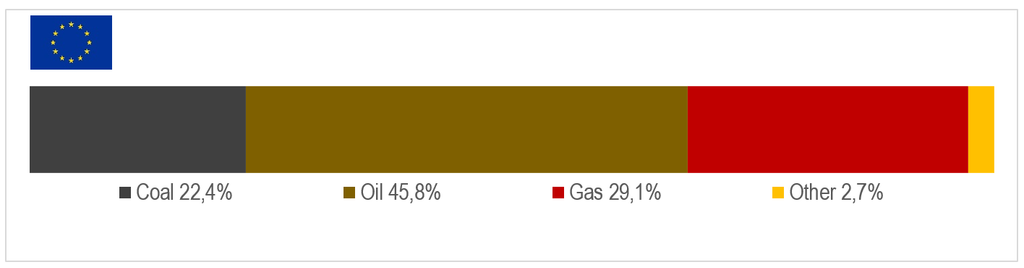
Chart 1: CO2 emissions by fuel, Europe, 2024. Source: International Energy Agency
Greece is reducing emissions, but dependence persists
In Greece, a significant decline in greenhouse gas emissions has been recorded since 2007, driven primarily by the phase-out of lignite-fired power generation, the rapid growth of renewable energy, and gains in energy efficiency (Graph 2). The contraction of economic activity during the economic crisis period also contributed to the reduction.
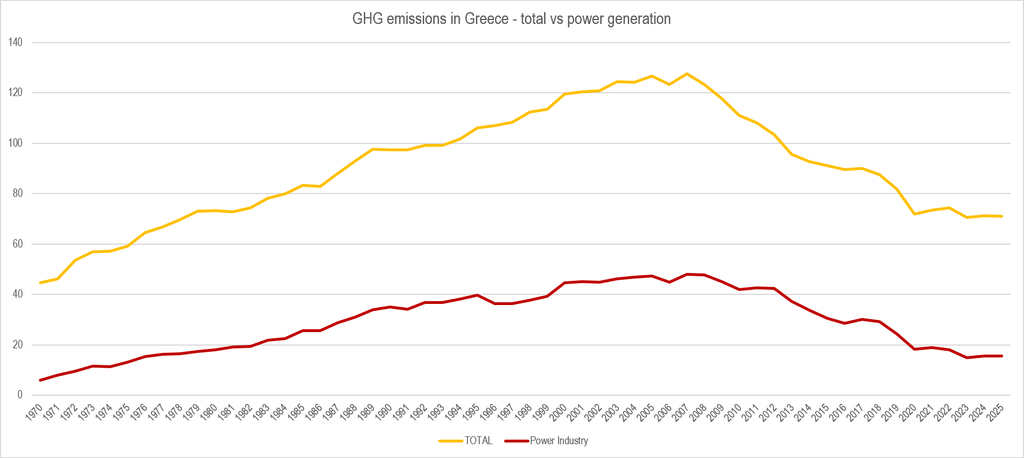
Figure 2: Evolution of total greenhouse gas (GHG) emissions and power generation emissions in Greece (1990-2025). Data source: EDGAR.
However, progress in power generation is not enough. Oil and gas still account for a significant share of the country’s energy emissions, while transport remains one of the major sectors for CO₂ emissions. Specifically, in 2024 oil accounted for nearly 69% of energy-related CO₂ emissions, while gas covered approximately 24% (Chart 3). In the same year, transport was the largest source of energy emissions in the country, accounting for about 39% of the total, while electricity and heat production followed with 32% (Chart 4).
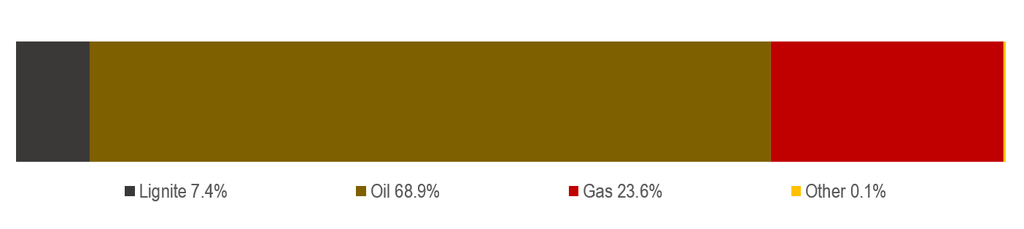
Chart 3: CO2 emissions by fossil fuel, Greece, 2024. Source International Energy Agency
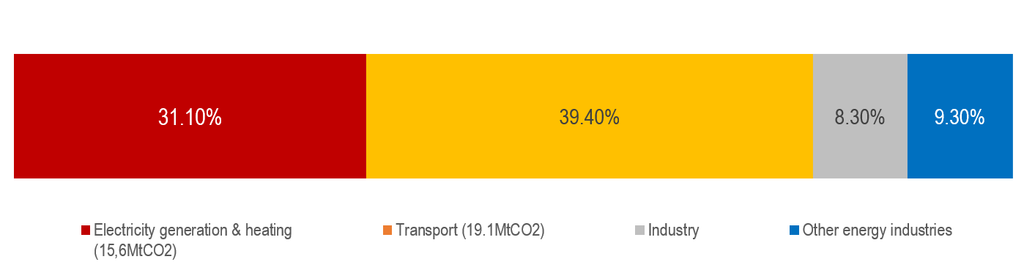
Figure 4: Breakdown of energy-related CO2 emissions in Greece by sector in 2024. Source: International Energy Agency
This means that the energy transition is not simply a matter of replacing lignite-fired plants. It requires electromobility, the bolstering of public transport, energy conservation, energy storage and the development of clean technologies across the entire economy.
How cheap is fossil fuel energy?
One of the main arguments in favour of fossil fuels—that they constitute the cheapest energy option—is now being challenged by the economic data itself.
Beyond the cost of power generation, an issue that is often overlooked is the decades-long channelling of substantial state aid into the production and consumption of fossil fuels. As already pointed out in an article on energiabook, according to openly available OECD data, between 2010 and 2024, €2,238,848,415 was paid out in state compensation solely to keep lignite-fired power plants in operation, and €2,353,565,115 respectively to gas-fired plants. The total amount of state aid that Greece reported to the OECD as having been paid annually under the state support mechanism for the use of fossil fuels in power generation amounted to €306,160,902.
At the same time, renewable energy sources have become highly competitive. According to the International Renewable Energy Agency (IRENA), 91% of new large-scale renewable energy capacity added in 2024 generated electricity at a lower levelised cost than the cheapest new fossil fuel-fired option. The average cost of electricity generation from new onshore wind projects was approximately $34/MWh, and from photovoltaic systems, $43/MWh.
At the same time, the cost of constructing new gas-fired power plants has increased, while the scarcity of gas turbines has nearly doubled construction expenditures: in the USA, they reached approximately $2,400/kW of installed capacity. This has sent the levelised cost of electricity (LCOE) from gas plants soaring to nearly $100/MWh in markets with higher gas costs, such as Italy, Germany and Japan. Even in markets where gas is cheaper, the LCOE remained in the $50–60/MWh range.
Naturally, the deployment of renewables requires upgrades to grids, storage and the flexibility of the electricity system. This cost must be factored into the overall planning of the energy transition. On the other hand, the true economic burden of fossil fuels is not limited to the construction and operating costs of plants. It includes public subsidies, import expenditure, health impacts from air pollution and the rising cost of the climate crisis’s impacts.
In other words, seemingly cheap fossil-fuel energy often conceals a significant economic, social and environmental cost.
The energy dilemma of the next decade
Greece and European countries characterised by a deep reliance on fossil fuels currently find themselves at a critical crossroads.
On the one hand, there are choices that prolong dependence on gas for decades, creating the risk of lock-in to fossil fuel infrastructure and increased energy costs. On the other hand, there is the possibility of accelerating investments in renewables, grids, storage, the electrification of transport and energy efficiency.
Clean energy with protection for nature and society
Phasing out fossil fuels is only one side of the energy transition. Of equally fundamental importance is the overall environmental and social footprint of the transition to a climate-neutral power generation model. Renewable energy projects cannot be treated exclusively as investment opportunities, but as critical public-interest infrastructure that serves a clear environmental purpose: tackling the climate crisis and protecting the natural resources upon which social well-being depends.
For this reason, RES projects must be designed and sited with strict environmental criteria, respecting biodiversity, protected ecosystems, forests, natural landscapes and the existing economic activities of local communities. A transition that reduces greenhouse gas emissions while simultaneously degrading the country’s natural capital undermines the very logic of sustainability.
Climate neutrality and the phase-out of fossil fuels are not only an environmental goal, but also a strategy for economic resilience, energy independence and national security. The longer investments in new hydrocarbon infrastructure with a long operational horizon continue, the greater the risk of prolonging dependence on fossil fuels.
The challenge is not simply more clean energy, but an energy system that simultaneously protects the climate, nature and society.
Data sources:
IEA – Global Energy Review 2026, CO₂ Emissions
IRENA – Renewable Power Generation Costs in 2024
JRC/EDGAR – GHG Emissions of All World Countries
European Environment Agency – Greenhouse Gas Emissions in Greece