
Emissions from the combustion of extracted oil have until now been excluded from environmental impact assessments. A simple, illustrative cost-benefit analysis exercise shows that the omitted cost can be comparable to or even greater than the private cost of extraction.
The ruling
On 13 November 2026, the Grand Chamber of the Supreme Court of Norway upheld the annulment of approvals for three North Sea oil fields: Breidablikk, Tyrving and Yggdrasil [1]. The reason was that the environmental impact assessments failed to evaluate the emissions resulting when the oil and gas are burned by end users, primarily abroad. These account for the vast majority of emissions associated with petroleum activity. The reasoning is straightforward: without extraction, the oil remains in the ground, therefore emissions from its combustion are a predictable consequence of the project and must be assessed before a permit is granted. The majority of the court additionally requested that cumulative emissions be examined alongside the other fields on the continental shelf. The ruling is based on the European Directive on environmental impact assessment, as interpreted by the EFTA Court [2].
The decision does not halt production: the companies were not parties to the case and their permits do not automatically cease to be valid [3]. Furthermore, the court asked for emissions to be estimated, not for the damage to be evaluated in monetary terms. The next step is a job for economists: how significant is this damage relative to the value of the oil? As part of the Cost-Benefit Analysis course I teach at the University of Macedonia, we attempted to answer this question.
An indicative exercise
The combustion of a barrel of crude oil releases approximately 0.43 tonnes of CO₂ [4]. To evaluate the damage, I used two scenarios.
The first is conservative. I take the market price of the European Union Emissions Trading System (EU-ETS), around €90 per tonne in November 2026 [5], as an indicative benchmark. This price is not an estimate of global climate damage; it is the price of a market for allowances. I use it to calibrate a simple model in which annual damage is proportional to the quantity of CO₂ remaining in the atmosphere, according to the residence curve used by the IPCC [6]. Almost half of the CO₂ remains after 80 years and about a fifth for millennia. I calculate the present value of the damage for 80 years using discount rates of 5%, 3% and 1.5%.
The second scenario uses the best-known scientific estimate of the Social Cost of Carbon (SCC): the US Environmental Protection Agency’s (EPA) 2023 values, based on Rennert et al. (2022, Nature) [7, 8]. For 2025 emissions, the SCC is 130, 210, and 360 dollars (2020) per tonne, at discount rates of 2.5%, 2%, and 1.5% respectively. The current US administration has stopped using them in regulatory policy [9], but they remain the most thorough estimate available.
The results are compared with the price of Brent under two scenarios: a high price of $95, close to November 2026 levels [10], and $69, the 2025 average prior to the war with Iran [11]. As an indicative private baseline cost, I use the break-even point for Aker BP’s portfolio of new projects, which includes Yggdrasil: $35–40 per barrel, calculated by the company at a 10% discount rate [12]. This is not the social cost of production for this specific field, but it gives a realistic order of magnitude.
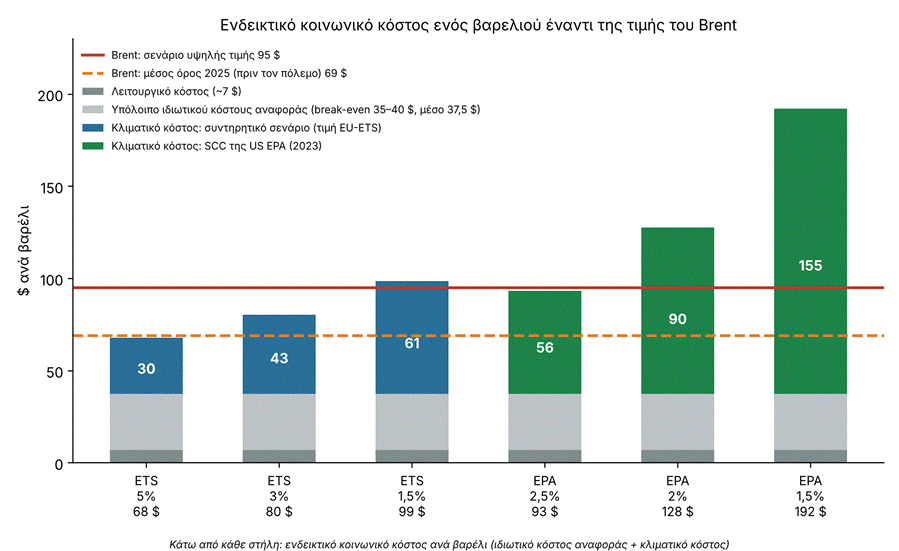
Chart: Indicative social cost of a barrel (private baseline cost and climate cost) under two valuation scenarios, against the price of Brent. Author’s calculations based on the text’s assumptions.
What the results show
In the conservative scenario, the climate cost of a barrel is $30, $43 and $61. With the EPA’s SCC, it is $56, $90 and $155. Today’s price is more than double the reference private cost, and even the pre-war price exceeds it by almost 85%, so privately extraction is highly profitable. However, the climate cost is of the same magnitude or larger: from 0.8 times the private cost in the most conservative scenario to over four times with the EPA’s SCC and a 1.5% discount rate.
With the EPA’s SCC and a 2% discount rate, the indicative social cost ($128) clearly exceeds even today’s high price. Even in the conservative scenario, with a 1.5% discount rate the social cost ($99) exceeds the price of $95, and at pre-war prices the indicative net social benefit is negative in all scenarios except the most conservative one.
Calculations show that incorporating climate damage can fundamentally alter the financial evaluation of an oil field. An investment with a high private return may, under reasonable but specific assumptions, yield a negative net social benefit. The result does not constitute a full cost-benefit analysis of the specific field, but it highlights the magnitude of the cost omitted when end-use emissions are left out of the assessment.
This is the essence of climate externality: a significant portion of the social cost of combustion is not reflected in the market price of oil. Even where carbon pricing mechanisms exist, their prices do not necessarily align with global marginal climate damage.
Reservations
The most important caveat concerns the difference between gross and net emissions. The court is requiring that emissions from the combustion of the field’s oil be evaluated. An economic analysis needs to estimate the additional global damage compared to a scenario where the field is not developed. If part of the Norwegian oil is replaced by oil from other producers, the net increase in emissions is smaller. In the conservative scenario with a 3% discount rate and a $69 price, a substitution of around 27% is enough for the outcome to become positive; with the EPA’s SCC and a 2% rate, around 65% is required. The degree of substitution is not a question of physical science but of economic behaviour, and it is worth estimating explicitly. The critical question is: if this oil is not extracted, what will take its place? The more other oil, the smaller the net damage of the field. The more clean sources or simply lower consumption, the greater it is.
There is also an interaction that makes the issue more interesting. The answer depends on how cheap and available renewables are. As the energy transition progresses, the more likely it is that a barrel not produced will be replaced by clean energy rather than by another barrel. This strengthens the argument against new fields with a lifespan of several decades, such as those planned in Greece.
The decision also serves as a reminder of the importance of timing. Assessment prior to investments allows for a meaningful comparison of all alternatives. Once investments have been made, sunk costs should not influence the decision to continue production: ex-post evaluation looks only at future costs and benefits, and may arrive at a different outcome from the initial one.
And what about Greece?
Greece is at the beginning of the road. In February 2026, contracts were signed with the Chevron–HELLENiQ ENERGY joint venture for four offshore areas south of Crete and the Peloponnese, ratified by Law 5287/2026, with seismic surveys scheduled from late 2026 [13]. The ExxonMobil–Energean–HELLENiQ ENERGY joint venture is planning an exploratory well in Block 2 west of Corfu in 2027 [14]. Environmental approval for the “South Peloponnese” programme was issued in December 2025 [15], while environmental organisations had pointed out shortcomings in the strategic study during the consultation, such as the complete omission of methane emissions [16], [17]. Greek approvals are already facing similar legal challenges, both before the Council of State and through a complaint by environmental organisations to the European Commission [18].
Greek targets focus mainly on natural gas, which emits less CO₂ per unit of energy than oil, but methane leaks must be added to this. The Norwegian ruling is of great jurisprudential significance for the interpretation of the Directive throughout the European Economic Area, although its application to specific Greek concessions requires an examination of the respective procedures and studies.
The real lesson of the Norwegian ruling is not that every new hydrocarbon extraction is necessarily socially unviable. It is that we cannot know whether an investment serves the public interest when we ignore a significant part of its cost. And this is precisely why a full and transparent assessment must precede the decision rather than follow the investment.
Sources
[1] Norges Høyesterett, ruling HR-2026-2428-S, 13.11.2026. https://www.domstol.no/no/hoyesterett/avgjorelser/avgjorelser-2026/hoyesterett—sivil/HR-2026-2428-S/
[2] EFTA Court, advisory opinion E-18/24, 21.5.2025.
[3] OE Digital / Reuters, «Norway’s Top Court Invalidates Three Offshore Oilfield Approvals», 13.11.2026. https://www.oedigital.com/amp/news/544344-norway-s-top-court-invalidates-three-offshore-oilfield-approvals
[4] US EPA, Greenhouse Gas Equivalencies Calculator – Calculations and References (factor of 0.43 t CO₂ per barrel of crude). https://www.epa.gov/energy/greenhouse-gas-equivalencies-calculator-calculations-and-references
[5] GMK Center, “European carbon prices exceeded €90/t in November”, November 2026; OPIS, 2026. https://gmk.center/en/news/european-carbon-prices-exceeded-e90-t-in-november/
[6] Joos, F. et al. (2013), “Carbon dioxide and climate impulse response functions for the computation of greenhouse gas metrics”, Atmospheric Chemistry and Physics 13, 2793–2825.
[7] US EPA (2023), Report on the Social Cost of Greenhouse Gases: Estimates Incorporating Recent Scientific Advances. https://www.epa.gov/system/files/documents/2023-12/epa_scghg_2023_report_final.pdf
[8] Rennert, K. et al. (2022), “Comprehensive evidence implies a higher social cost of CO₂”, Nature 610, 687–692.
[9] E&E News, «White House bars agencies from using social cost of carbon», 9.5.2025. https://www.eenews.net/articles/white-house-bars-agencies-from-using-social-cost-of-carbon/
[10] Trading Economics, Brent crude oil, November 2026. https://tradingeconomics.com/commodity/brent-crude-oil
[11] US EIA, «Crude oil prices fell in 2025 amid oversupply», 5.1.2026. https://www.eia.gov/todayinenergy/detail.php?id=66944
[12] Aker BP, Production outlook (Q3 2023): portfolio break-even $35–40/barrel with a 10% interest rate; Aker BP, Q3 2025 conference call: unit production cost ~ $7/boe. https://akerbp.com/wp-content/uploads/2023/11/2023-q3-production-outlook.pdf
[13] Powergame.gr, “Hydrocarbons: Signatures placed on concession agreements with Chevron-HelleniQ Energy”, 16.2.2026; Naftemporiki, exploration timetable; The Press Project, ratification by Law 5287/2026.
[14] Newmoney.gr, “Hydrocarbons: Chevron and ExxonMobil bring new drilling to Ionian and Corfu”, 2026.
[15] ot.gr, “Chevron: Green light for environmental terms for the ‘South Peloponnese’ block”, 11 Dec. 2025. https://www.ot.gr/2025/12/11/energeia/fysiko-aerio/chevron-prasino-stous-perivallontikous-orous-gia-to-block-notia-peloponnisos/
[16] Greenpeace Greece, “Hydrocarbon extraction in the South Peloponnese too?”, 13 May 2025 (comments by WWF Greece, Pelagos, and Greenpeace on the SEA). https://www.greenpeace.org/greece/issues/klima/57968/exoryxi-ydrogonantrakon-kai-sti-notia-peloponniso/
[17] https://www.wwf.mg/?20854866/————–
[18] ClientEarth, “NGOs urge European Commission to intervene as Greece flouts EU law for benefit of oil and gas activities”, 14.12.2023, https://www.clientearth.org/latest/press-office/press/ngos-urge-european-commission-to-intervene-as-greece-flouts-eu-law-for-benefit-of-oil-and-gas-activities/ · Greenpeace Greece, “Appeal against the hydrocarbon extraction programme in Crete heard today at the Council of State”, https://www.greenpeace.org/greece/issues/klima/47622/ste-prosfygi-exoryxeis-kriti/