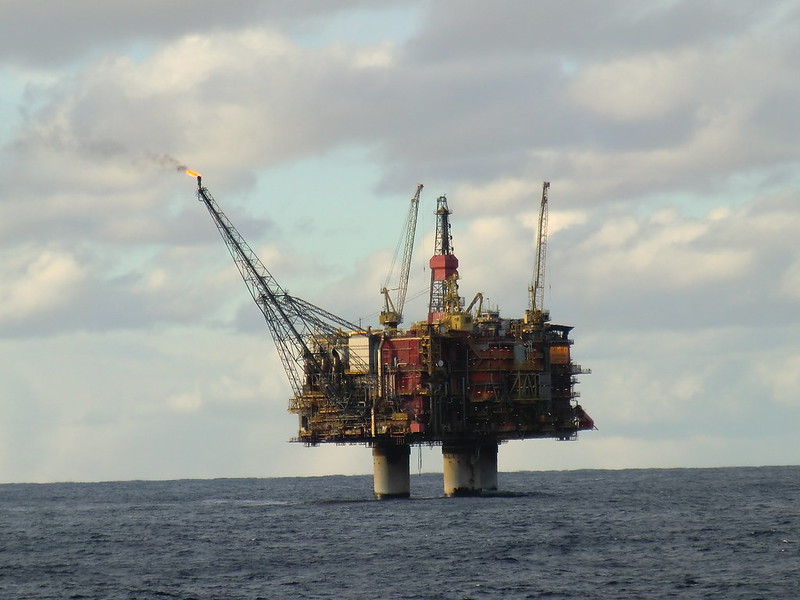
One of the most significant judicial decisions regarding the climate footprint of fossil fuels and the responsibility of public administrations to approve extraction projects only on the basis of a thorough assessment of the impacts of the resulting emissions was issued on 13 November 2026 by the Supreme Court of Norway. The ruling concerns the development approvals for the Breidablikk and Tyrving oil fields, as well as the major Yggdrasil complex in the North Sea. The license holders for these areas are Equinor Energy AS, Vår Energi ASA, Petoro AS, and ConocoPhillips Skandinavia AS.
Background to the case
The case stems from a legal challenge brought by environmental organisations Greenpeace Norway and Natur og Ungdom, which argued that Norwegian authorities breached the law by approving the hydrocarbon exploration and extraction projects without considering the greenhouse gas emissions that will result when the oil and gas are burned by end consumers.
The case was initially decided by the Oslo District Court, where a lawsuit was filed against the Norwegian Ministry of Energy on 29 June 2023. The plaintiff environmental organisations also sought an injunction, arguing that the court should oblige the state to suspend the validity of the decisions. On 18 January 2024, the Oslo District Court invalidated the approvals for the three offshore areas and prohibited the relevant authorities from issuing new approvals until the case is finally judged. Lastly, the court awarded legal costs of 3,260,427 kroner (€309,162).
The Norwegian state appealed against the first-instance ruling. The court of appeal decided in July 2024 to stay the proceedings and refer the case for an advisory opinion to the Court of Justice of the European Free Trade Association, which issued its advisory opinion on 21 May 2025 (Case E-18/24). According to the EFTA Court, European law on environmental impact assessment requires the impact study to include emissions from combustion. Taking into account the opinion of the EFTA Court, the competent Norwegian court of appeal dismissed the appeal by the Norwegian state, which had sought the annulment of the first-instance decision.
Subsequently, the Norwegian state appealed to the Supreme Court, seeking the annulment of the relevant Court of Appeal’s decision. On 13 November 2026, the Supreme Court rejected the Norwegian state’s final attempt to maintain the validity of its original decisions approving the plans for development and operation (PUD) of the Breidablikk and Tyrving oil fields, as well as the Yggdrasil area, which consists of three fields in the North Sea.
Crucial question of the trial: which emissions count?
The case focused on so-called “combustion emissions”. As the court notes in its reasoning, “combustion emissions mean the greenhouse gas emissions that occur when the oil and gas extracted from the oilfields are burned after sale. Greenhouse gas emissions resulting from the actual development and production at the fields are referred to as production emissions. Combustion emissions account for approximately 95% of total greenhouse gas emissions from oil extraction in Norway, while production emissions account for approximately 5%. The majority of the oil produced in Norway will be exported and burned abroad.”
Until today, environmental assessments have focused mainly on emissions caused during the exploration, extraction and primary processing phase of hydrocarbons. The Supreme Court ruled that this is no longer sufficient.
The court’s reasoning
Relying on a previous advisory opinion of the EFTA Court, the Supreme Court decided that the emissions resulting from the combustion of the produced oil and gas constitute a foreseeable and inevitable consequence of extraction projects and must therefore be assessed before development permission is granted. The rationale is simple yet particularly powerful: without extraction, the oil and gas would remain underground and the associated emissions would not be released into the atmosphere. Consequently, there is a direct causal link between the approval of an oil project and the future emissions that the consumption of its products will generate.
The court also stressed that the environmental assessment must take place prior to the approval of a project, so that both the authorities and the public are able to fully evaluate its consequences while all alternatives remain open.
A further step: cumulative impacts
Of particular significance is the fact that the majority of the court ruled that evaluating the emissions of each project separately is not sufficient. Environmental impact assessments must also examine the cumulative emissions from other already approved or existing oil projects on the Norwegian continental shelf. In this way, authorities and society gain a more comprehensive picture of the total climate footprint of Norwegian oil activity.
The Supreme Court found that the initial project approvals had been issued without assessing combustion emissions, and that subsequent supplementary procedures did not fully remedy the issue because they failed to examine the cumulative emissions from the remaining fields on the Norwegian continental shelf.
As a result, it rejected the appeal by the Norwegian state and upheld the ruling that the decisions of the Ministry of Energy were invalid due to shortcomings in the environmental assessment process. At the same time, the court clarified that the annulment does not automatically imply the stoppage of the projects. However, it creates an obligation for the administration to re-examine the approvals based on the requirements set by the decision.
Broader significance for Europe
The ruling resonates far beyond Norway’s borders. It represents one of the strongest judicial affirmations in Europe that the climate impacts from the eventual combustion of oil and gas must be fully considered before new extraction projects receive approval. Equally significant, the judgment reinforces the democratic principles of public participation and transparency, confirming that citizens and civil society have the right to a complete understanding of a project’s climate consequences before decisions are made on major fossil fuel developments.
In Greece, a similar case is pending before the Council of State regarding the offshore area “South of Peloponnese“. According to the relevant ground for annulment, the approved study failed to assess the impact of total emissions generated across all phases of the area’s exploitation, as well as the combustion of the hydrocarbons that the companies estimate they will extract.
For the climate policy of both the EU and its member states, the ruling marks the end of the era in which governments could evaluate only the direct emissions of oil facilities. From now on, increasing weight will be placed on the full climate footprint of fossil fuel projects, including the emissions generated when these products are ultimately burned.
As Haldis Tjeldflaat Helle, spokesperson for the Norwegian office of Greenpeace, stated: “This historic ruling changes Norwegian oil policy forever, and sets a precedent the world cannot ignore. Norway can no longer ignore the global damage caused when its oil and gas are burned abroad. Norwegian authorities are now obligated to take into account the enormous climate damage caused by Norwegian oil and gas. This is a momentous victory for global climate justice.“
Related sources:
- Supreme Court (Norges Høyesterett): https://www.domstol.no/no/hoyesterett/avgjorelser/avgjorelser-2026/hoyesterett—sivil/HR-2026-2428-S/
- Greenpeace announcement: https://www.greenpeace.org/international/press-release/87146/norway-supreme-court-north-sea-oil-gas-approvals-invalid-historic-climate-legal-case/