Within three weeks, all three EU institutions came out in favour of postponing the methane regulation. On 14 October, the Commission proposed a one-year delay for key obligations on oil, fossil gas and coal importers. On 22 October, the European Parliament voted in favour of a three-year postponement. On 6 November, the Council agreed on one year, with the possibility of more, as we have already reported on energiabook. Ultimately, Parliament and Council agreed on a two-year postponement: the importers’ obligations will apply from 1 January 2029 instead of 1 January 2027 (Reuters).
The postponements were presented as a response to the energy crisis following the US-Israel war with Iran. The Fossil Free Politics report “Stripping Down the EU Methane Regulation: How the Fossil Fuel Industry Lobbies to Water Down a Landmark Climate Law” (October 2026) paints a different picture. The postponement was a goal of the industry long before the crisis, and the industry worked systematically towards it in Brussels and national capitals.
One meeting a week
Between January 2025 and July 2026, the European Commission discussed the regulation in 110 meetings with external stakeholders. 82 of these, meaning three out of four, were held with companies or associations from the fossil fuel sector. If cross-sector business associations with fossil fuel members are added, the percentage exceeds 80%. Environmental and other civil society organisations held 13 meetings, amounting to 12%. On average, the Commission met with the industry once a week.
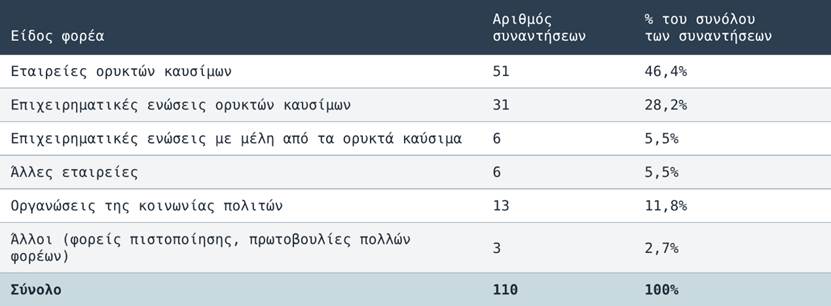
Table: European Commission meetings on the methane regulation by type of stakeholder (January 2025 – July 2026). Source: Fossil Free Politics (2026), Table 2, p. 10.
A total of 31 companies and 11 industry associations took part in the meetings. The industry also submitted at least 18 letters, reports and draft amendments, averaging almost one per month.
These figures do not count all relevant meetings, but only those from the Commission’s published data and minutes. Meetings held in 2025 that had not been declared in the Transparency Register have also been uncovered (Euronews).
What the industry demanded
The demands are written in the industry’s own texts. In April 2026, an alliance of industry associations demanded a postponement of importer obligations, a “standstill” mechanism and amendments (joint letter, joint proposals). IOGP Europe submitted 15 amendments for looser requirements (IOGP Europe). Eurogas asked for lower fines (Eurogas).
The industry also insistently pushed for the regulation to be included in the Energy Omnibus, the package through which the Commission amends multiple laws simultaneously in the name of “simplification” and competitiveness. This would open up the legislative text itself to changes. The request found resonance: in June 2025, the Council Energy Presidency conclusions stated that existing energy legislation might need simplification, “for example in the context of the methane regulation” (Council). IOGP Europe welcomed it two days later (IOGP Europe).
What it had already won before the postponements
Before this year’s delays, industry had already secured a relaxation in the implementation of the regulation. In July 2026, the Commission recommended that member states should not impose penalties—a grace period—on importers for three years, namely until 2029 (Recommendation 2026/1835). Environmental organisations described this as a “backdoor implementation freeze” (CAN Europe et al.).
The crisis argument
Following the war with Iran and the closure of the Strait of Hormuz, security of supply became the primary argument. IOGP Europe warned of a “severe disruption” to Europe’s supply from 2027 (IOGP Europe). Within a week of the outbreak of the war, a Wood Mackenzie study—commissioned by IOGP Europe and Concawe, the research arm of FuelsEurope—was already in circulation. The study argues that approximately 43% of gas (114 bcm) and 87% of crude oil (9.8 million barrels per day) of the Union’s 2024 imports could be non-compliant with the regulation, and that postponing importers’ obligations by three (3) to four (4) years could help avoid severe supply disruptions (Wood Mackenzie). Its figures quickly found their way into the public discourse of governments (Rapporteur).
The data do not support these claims. According to an analysis by Rystad Energy (June 2026), the recent rise in gas prices is driven by the Strait of Hormuz rather than the regulation: prices rose simultaneously in Europe and Asia, indicating a global shock. The same analysis finds that available gas and oil supply that meets the highest level (Level 5) of OGMP 2.0—the UN Environment Programme’s (UNEP) methane measurement standard—is three times higher than current EU imports (Rystad Energy). According to Data Desk, long-term contracts signed after 4 August 2024 with a final destination in the EU correspond to approximately 21 billion cubic metres of deliveries per year up to 2027 and 30 billion up to 2030. This is approximately 7% and 10% of the gas imported and consumed by the EU in 2025.
Carbon Limits adds that full compliance with methane monitoring, reporting and verification requirements costs a mere 0.03% to 0.6% of the value of production. The Rystad and Carbon Limits studies were conducted on behalf of the Environmental Defense Fund, and the Wood Mackenzie study on behalf of industry.
From Brussels to capitals
The pressure did not stop at the Commission. According to the report, industry lobbied the governments of Germany, the Netherlands, Italy and Poland. The US played a significant role: over a quarter of the Commission’s meetings with corporate entities involved American companies and associations.
Pressure from the US also came directly from its government. As early as the autumn of 2025, the US administration told Brussels that “if you want US natural gas to come to the EU, you have to change the legal and regulatory framework” (Rapporteur). In June 2026, the US Department of Energy, alongside Qatar, Nigeria and Algeria, warned that the regulation could disrupt Europe’s supply (U.S. Department of Energy). Within two years, the US doubled its gas exports to Europe, and today it provides over 60% of the EU’s LNG (Rapporteur). It is therefore the supplier with the most to lose from the regulation.
Initially, the Commission did not back down, and following a meeting with the US side, ruled out any “change in ambition”. Its stance shifted after the war with Iran. Germany began pushing for a three-year delay, and eventually even France publicly spoke out in favour of a one-year postponement (Rapporteur).
At the Energy Council on 26 June, seventeen governments backed the demand by Czechia and Slovakia for a three-year postponement (meeting video). Greece was among them (Fossil Free Politics, 2026). In October, when the Council discussed the Commission’s proposal, it was once again in the bloc supporting the three-year delay (EUobserver).
The industry’s “vocabulary”
Industry speaks of delay, but asks for postponement. It speaks of simplification, but means watering down. It speaks of “targeted amendments”, “flexibility” and “legal certainty”.
Methane is responsible for about 30% of global temperature rise since the Industrial Revolution (IEA). Around 70% of its emissions from fossil fuels can be avoided using technologies that already exist (IEA). Greece is located in the Mediterranean, one of the regions where climate change is manifesting most acutely. Europe has just experienced its deadliest summer in the past 26 years: climate change is responsible for roughly 50,000 heat-related deaths in European cities in the summer of 2026.
Every year of postponement comes with a cost, and it is not paid by those who pushed for the delay.
Sources
Fossil Free Politics (October 2026). Gutting the EU’s Methane Rules: How the Fossil Fuel Industry Is Lobbying to Weaken a Landmark Climate Law. https://fossilfreepolitics.org
Carbon Limits for the Environmental Defense Fund (2026). EU MR MRV Compliance Costs. https://library.edf.org/AssetLink/3ainnj0r3k218yosg8o52570v124m0y2.pdf
Data Desk (24 June 2026). EU Methane Regulation and security of supply. https://research.datadesk.eco/eumr-supply/
IEA (2026). Global Methane Tracker 2026. https://www.iea.org/reports/global-methane-tracker-2026
Rystad Energy for the Environmental Defense Fund (June 2026). Navigating the future of energy: EU energy security considerations in light of EU MER & the Middle East conflict. https://library.edf.org/AssetLink/7000haw3l6ml1w87b58kilq13tirkfoh.pdf Wood Mackenzie for IOGP Europe and Concawe (March 2026). EU Methane Emissions Regulation – Analysis of Market Impacts. https://www.concawe.eu/wp-content/uploads/2026_03_10-EU-Methane-Emissions-Regulation-Study-1.pdf