At the 31st UN Climate Change Conference (COP31) in Antalya, Saudi Arabia, representing the Arab Group, defended references in the text to carbon capture and storage (CCS) and rejected claims that the technology constitutes greenwashing. It also opposed explicit references to a phase-out of fossil fuels, as we have reported. The conference ultimately concluded without an agreement.
But what happens when carbon dioxide (CO2) is put underground? What is the risk and who pays if things do not go as planned?
How carbon dioxide is stored
CO2 can be stored in three main ways. The first is Enhanced Oil Recovery (EOR): CO2 is injected into a reservoir to help extract more oil. The second is deep saline formations, meaning porous rocks filled with saltwater. The third is depleted oil and gas reservoirs.
According to a new analysis by the independent Institute for Energy Economics and Financial Analysis (IEEFA) on the risks of underground CO2 storage, out of 113 CCS facilities recorded globally, 53 are linked to enhanced oil recovery, 41 to saline formations, and just 6 to depleted reservoirs.
In other words, nearly half of the facilities use CO2 to increase oil production. Saline formations account for 96% of potential storage space, but much of it has not been studied in detail.
However, as IEEFA notes, the fact that a geological formation appears suitable does not guarantee either that it will ultimately be able to accept CO2 at the designed rate or that it will keep it underground.
Each method of CO2 storage carries different risks
In saline formations, because the rocks are already full of water, injecting CO2 increases subsurface pressure. In that case, injection must be slowed down or pressure-relief methods applied, such as pumping water out of the formation.
The Gorgon project in Western Australia is one of the largest in the world and has been accepting CO2 separated from fossil gas during processing since 2019. The amount of CO2 it ultimately stores is much lower than the initial design of 3.3–4 million tonnes per year. The main obstacle, as emerged from a 2026 independent assessment, was that pressure management capacity was insufficient for the designed CO2 injection rate.
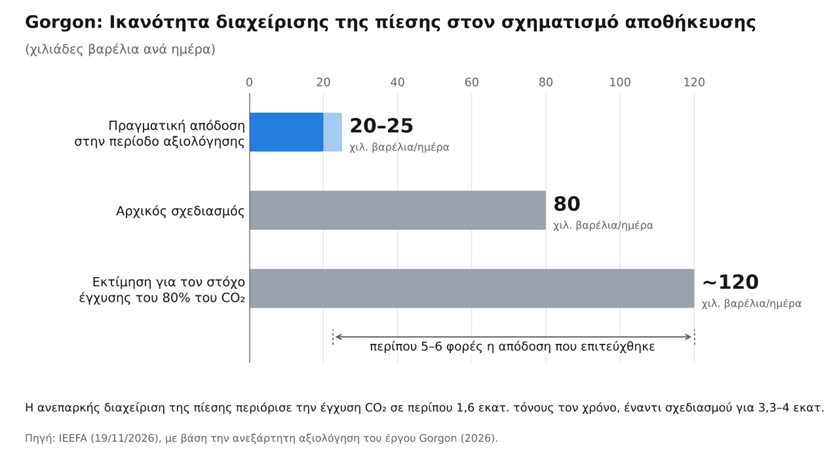
Pressure management capacity at the Gorgon project. Source: IEEFA, based on the 2026 independent assessment.
As shown in the chart above, Gorgon’s pressure management system was designed for 80,000 barrels per day, but in practice it delivered only 20,000–25,000. According to the assessment, achieving the target would require about 120,000 barrels per day, meaning five to six times more. Gorgon gas contains CO2, which is removed before liquefaction. Project approval required at least 80% of this CO2 to be stored underground. However, between October 2022 and June 2025, only 30% was stored, falling far short of the initial target.
At Norway’s Snøhvit project, commonly cited as a successful project, injection began in 2008 into a formation expected to accept injections for about 18 years. However, pressure rose faster than expected. In 2011, injection was shifted to a shallower layer communicating with the producing gas reservoir, and in 2016 a new well was needed elsewhere in the reservoir to reduce the risk of CO2 reaching the fossil gas reservoir.
Depleted reservoirs: the biggest risk is old wells
Depleted reservoirs have one advantage: decades of production have provided a wealth of data on reservoir geology, pressure and fluid behavior. Moreover, extraction has reduced pressure, particularly in gas reservoirs, leaving more room for injection. Pressure, as we have seen, is the core problem in saline formations.
The most serious risk in depleted reservoirs is old wells. Some were sealed before CO2 storage was even designed, and they can become pathways for CO2 leakage. Furthermore, years of extraction have altered the stresses on faults and caprocks, and the renewed pressure build-up can reactivate faults or open fractures.
At In Salah in Algeria, where CO2 was injected into the aqueous section of an active gas reservoir, CO2 reached an old exploration well in 2007 and a small quantity leaked from a valve. Injection at a nearby well was suspended for over two years and resumed only in November 2009, after the old well was permanently plugged.
Who pays the risk
When the subsurface ultimately fails to behave as predicted, the financial risk, and above all the risk of leaks, does not disappear.
The long-term risk of leakage is difficult to quantify financially. CO2 must remain underground for centuries, whereas a project operates for a few decades. According to the International Energy Agency (IEA), cited by IEEFA, banks and investors struggle to calculate, price and insure this liability. Therefore, in practice, the state largely assumes it. At Gorgon, for example, IEEFA estimates that the actual cost reached 265 Australian dollars per ton, nearly four times the initial estimate of 70 dollars. The Western Australian government has agreed to cover certain third-party claims related to injection, no earlier than 15 years after its completion. Eighty percent of the amount will be covered by the federal government.
In the European Union, Directive 2009/31/EC on the geological storage of CO2 follows the same logic. While the storage site is operational, the project operator must hold financial guarantees and surrender emission allowances under the Emissions Trading System (ETS) for every ton leaked. After closure, liability passes to the state. The operator pays a financial contribution that must cover at least the estimated monitoring costs for 30 years. Whatever happens thereafter is assumed by the state.
Carbon storage can play a role for emissions that cannot otherwise be avoided. However, experience from projects already in operation shows that the subsurface does not always behave as planned and that the bill for what remains underground is ultimately paid by the state. This is why this technology cannot become an alibi for continuing to burn fossil fuels.
Sources:
IEEFA (2026), Different geology, different risks: what can go wrong underground in carbon capture and storage?, 19 November 2026, https://ieefa.org/resources/different-geology-different-risks-what-can-go-wrong-underground-carbon-capture-and
Directive 2009/31/EC of the European Parliament and of the Council of 23 April 2009 on the geological storage of carbon dioxide and amending Council Directive 85/337/EEC, Directives 2000/60/EC, 2001/80/EC, 2004/35/EC, 2006/12/EC, 2008/1/EC and Regulation (EC) No 1013/2006, OJ L 140, 5.6.2009, https://eur-lex.europa.eu/legal-content/EL/TXT/PDF/?uri=CELEX:32009L0031